
HISTORY & MEMORY · NOVEMBER 10, 2026

The Harlem Hellfighters: 191 Days on the Front Line

The Army’s record connects a regiment’s combat endurance with one soldier’s courage and the long delay between service and full recognition.

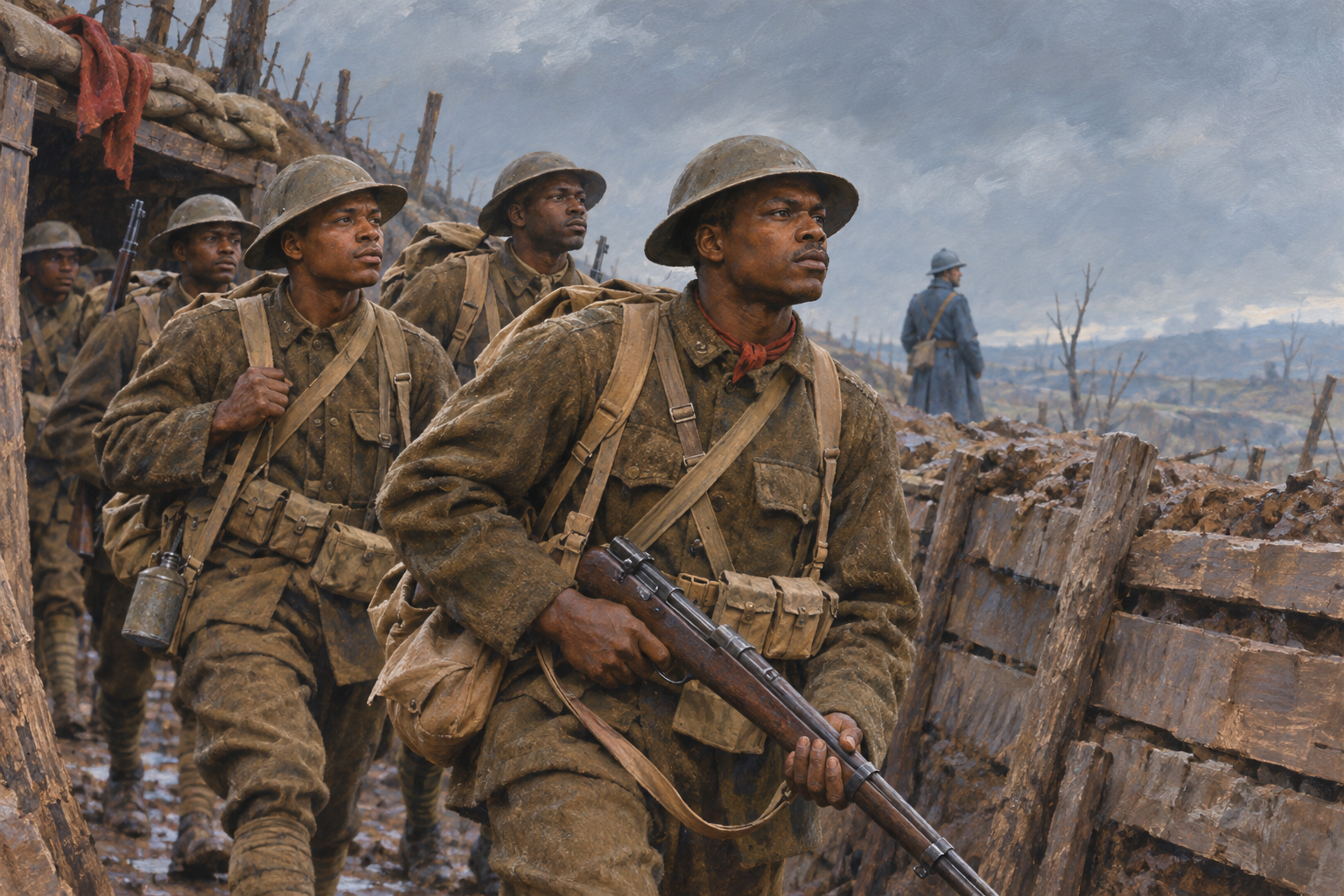
Editorial illustration of Harlem Hellfighters during World War I.
Generated editorial illustration for VHVATC’s history series. It is not an archival photograph or historical artifact.

The 369th Infantry earned the name Harlem Hellfighters in combat. Its record also shows how Black soldiers could be relied upon in war while being segregated within the Army and recognized slowly afterward.

A regiment the Army tried to keep separate

The U.S. Army’s account of Sergeant Henry Johnson explains that racial discrimination and segregation shaped where African-American units could serve. The 369th Infantry was assigned to the allied French Army rather than placed alongside white American units.

The regiment’s combat record was unmistakable. The Army records that the 369th spent 191 days in front-line trenches and earned a regimental French Croix de Guerre, along with more than 170 individual Croix de Guerre medals.

Henry Johnson on May 15, 1918

Henry Johnson was born William Henry Johnson in Winston-Salem, North Carolina, enlisted on June 5, 1917, and served in Company C of the 15th New York Infantry, the unit that became the 369th Infantry. In France on May 15, 1918, he defended against a German raiding party while on sentry duty.

The official Army page records that Johnson sustained 21 combat injuries. France awarded him the Croix de Guerre with Palme on February 12, 1919. The account preserves the action, the injuries, and the recognition without pretending that one award settled the larger history.

Recognition late but not erased

Johnson died in July 1929. His Purple Heart was awarded posthumously in 1996, and he received the Distinguished Service Cross posthumously in 2002. In 2015, he was posthumously awarded the Medal of Honor in a ceremony at the Pentagon.

The timing is part of the story. The record of courage existed before the nation finished naming it. Remembering Johnson means remembering both what he did in 1918 and how long official recognition took to catch up.

THEN · NOW · JOIN

Honor the record. Make the next step clearer.

This history stands on its own. The present-day work also deserves clear evidence, plain language, and a defined invitation.

THENThe historical record

The Harlem Hellfighters show combat service under segregation; Henry Johnson shows how recognition can arrive decades after the act it honors.

NOWVHVATC Today

VHVATC’s public pages describe practical ways Veterans and families can seek support and navigation today. That current work is kept distinct from the World War I record.

JOINA reader’s choice

Read the Army’s record, share the history of the 369th, and connect with VHVATC if you want to contribute time, partnership, support, or a question about services.

SEE THE WORK BEFORE YOU FUND THE MISSION

Evidence should come before the ask.

NEED

The historical need was equal recognition for soldiers whose combat service was real even when the institution remained segregated.

WHAT THE RECORD SHOWS

The Army documents 191 front-line days for the 369th and the staged recognition of Henry Johnson’s service.

WHERE & WHEN

The story follows the 369th in France during World War I and Johnson’s May 15, 1918 combat action.

EVIDENCE AVAILABLE

The official Army Medal of Honor page and Army retrospective are linked above.

WHAT SUPPORT COULD MAKE POSSIBLE NEXT

A visible, source-led history series can help communities connect memory to present-day Veteran support without substituting one for the other.